19 Classy Bantu Knots 2027 for Defined Coils
Classy Bantu Knots 2027 with 19 neat uniform knots for thick curly hair. Discover well-defined coily and elegant black hairstyles.

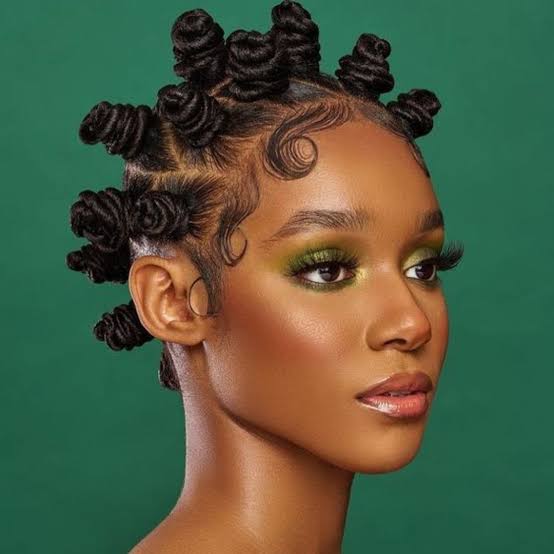
Bantu knots are a protective style built from twisted sections of hair coiled into flat spirals against the scalp. This season, the trend leans into glossy natural texture and soft face-framing layers, so the knots read as polished rather than severe.
This collection of 19 looks spans the range from low-upkeep everyday knots to intricate, accessorized versions for events. It suits thick, coily, and curly textures at neck length or longer, and works for anyone who wants a neat style that lasts several days. Classy Bantu Knots solve the problem of fine hair that falls flat by giving it structure and lift at the roots.
01. Neat Uniform Bantu Knots
Every single knot sits at the same height and angle, which means each section was twisted with the same tension before being coiled into place. The middle parting splits thick, coily black hair into two symmetrical halves, and from there the knots march back in tidy rows. Ask your stylist for: neat uniform bantu knots, middle parting. Short hair works best here, because the knots stay compact and don’t droop. The precision is the whole reason this style looks deliberate and tidy.
02. Polished Thick Curly Bantu Knots
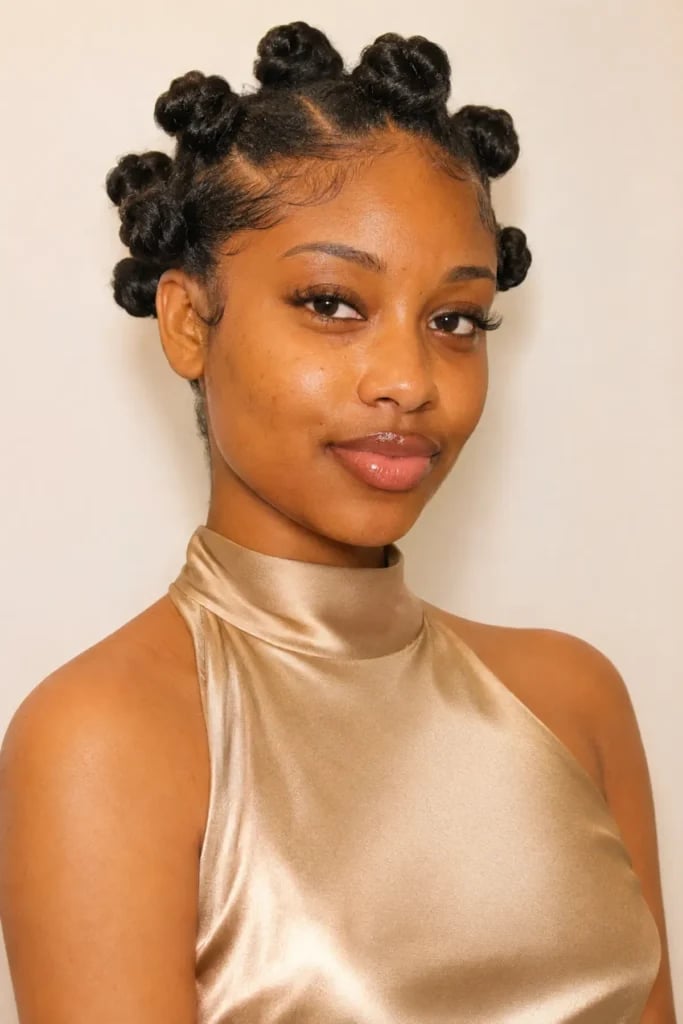
Can thick curly hair hold a knot without slipping? Yes, and this style proves it. The natural curl pattern gives each twist enough grip to stay coiled, so the knots keep their shape without constant re-tucking. A middle parting divides the short black hair evenly, and the uniform knots sit close to the scalp for a sleek finish. Ask your stylist for: uniform bantu knots, middle part. Apply a small amount of styling cream to each section before twisting for definition. A trim every six to eight weeks keeps the ends neat.
03. Neatly Sectioned Black Bantu Knots
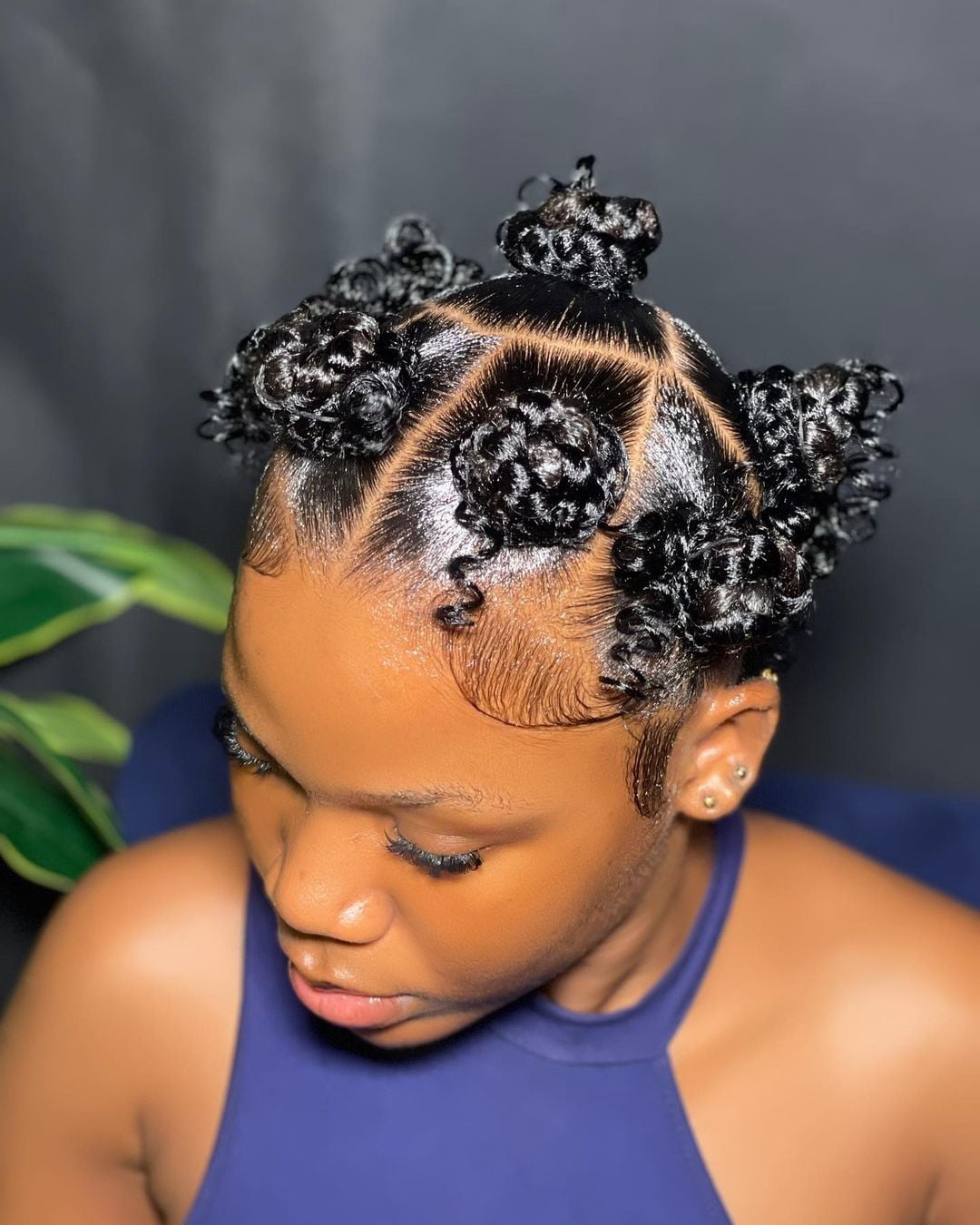
The parting lines here are as clean as the knots themselves. Each section is isolated by a razor-sharp part, which is what gives the style its glossy, structured finish. Ask your stylist for: neatly sectioned bantu knots, middle part. Thick, curly black hair of short length provides enough density for each knot to appear full without looking bulky. A fine-tooth comb is essential for mapping out the parts before twisting begins. Without those precise lines, the polish disappears.
04. Well-Defined Coily Bantu Knots
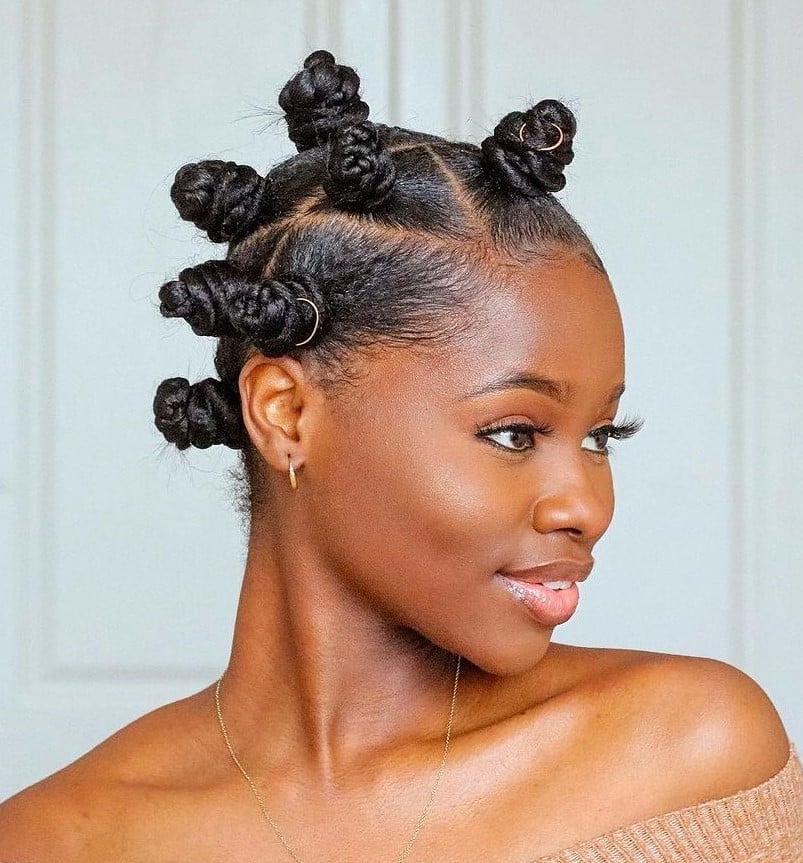
These knots are tighter and more defined than a looser twist-out, and that difference matters. A twist-out gives you volume and wave, but a well-defined bantu knot sits neatly and holds its shape for days. The neat parting and coily texture of the short black hair make each knot distinct rather than blurring into the next. Ask your stylist for: well-defined bantu knots, neat parting. If you want a style that stays crisp longer than a braid-out, this is the one.
05. Elegant Thick Black Bantu Knots
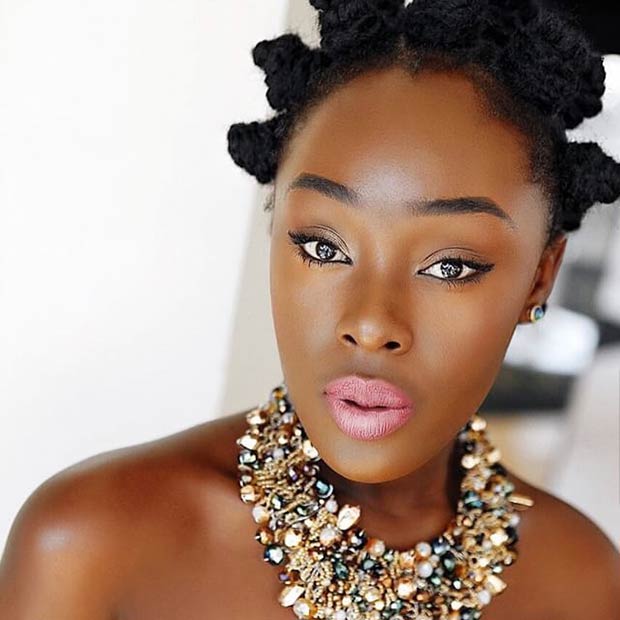
Tightly coiled knots last longer than loosely wrapped ones, but they also pull more at the scalp. The trade-off is worth it if you want a style that stays intact for a full week. Each knot in this set is coiled snugly and tucked under itself, so nothing unravels overnight. Ask your stylist for: elegant bantu knots, middle part. Thick, coily short hair holds the tension well. A trim every eight weeks prevents split ends from fraying the knots.
06. Small Structured Bantu Knots
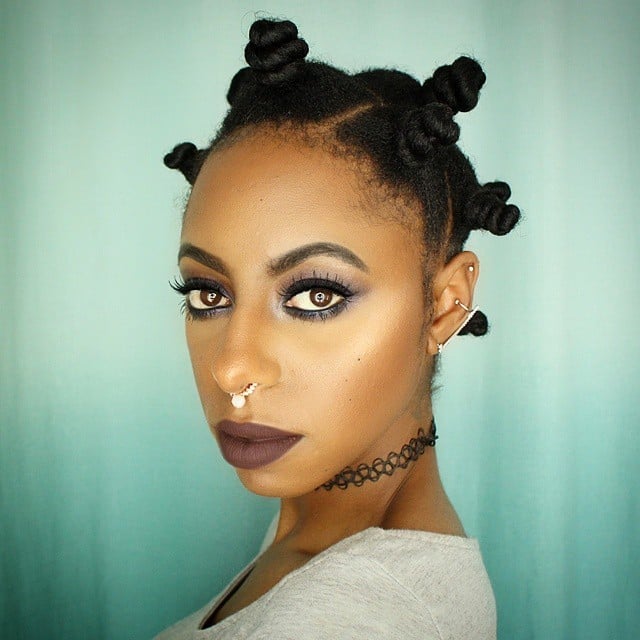
How many knots is too many? When they are small, tightly coiled and arranged across the scalp, the answer is surprisingly high. Thick coily hair at a short length holds this dense pattern best. Ask your stylist for: small tightly coiled bantu knots, middle part. This is a salon-only job: sectioning precision and even tension are the difference between a style that lasts and one that unravels by midday. A rat-tail comb and a firm gel on each section before twisting keep every knot anchored.
07. Bantu Knots With Gold Hoop Accessories
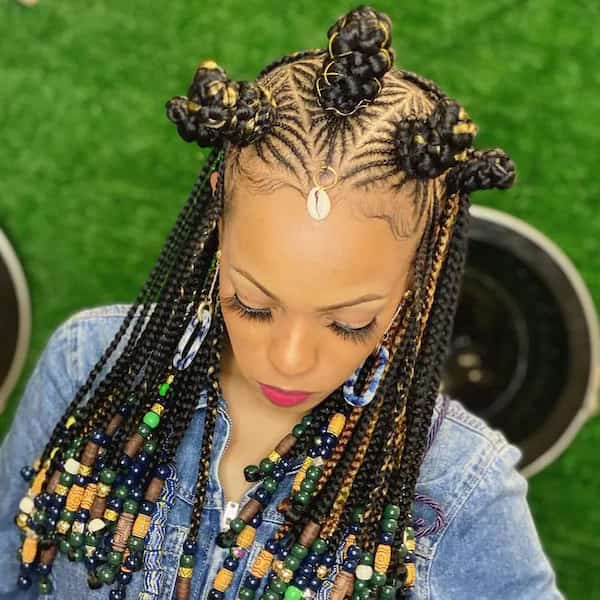
The design is simple: small gold hoops tucked into the base of each knot. That single metallic accent shifts the whole style from casual to party-ready. Thick, coily hair at a short length provides the grip these hoops need to stay put. Ask your stylist for: bantu knots with gold hoop accessories. This look lands best for holiday gatherings or a night out where the dress code says polished but not fussy. The hoops catch light subtly, no glitter required.
08. Bantu Knots With Gold Hair Accessories
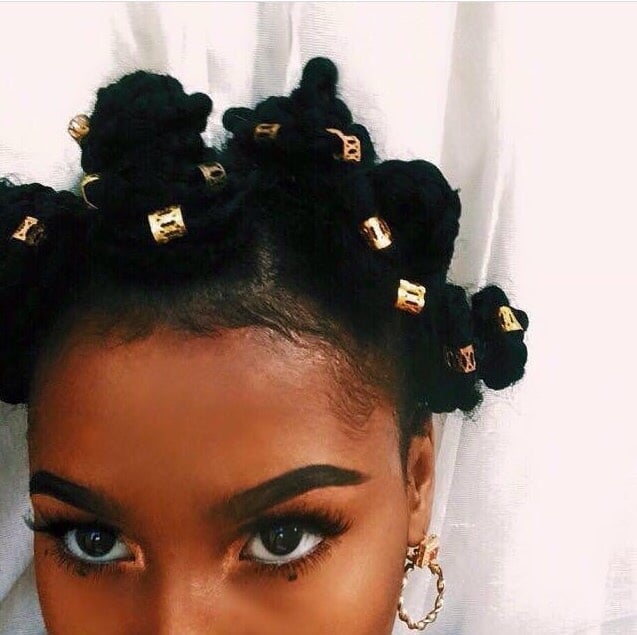
The gold accessories sit at the center of each knot, not at the edge. That placement matters: it lets the coiled hair wrap around the metal instead of competing with it. Thick, coily hair of short length works best here. Ask your stylist for: bantu knots with gold hair accessories. The accessories can slide forward if the knot is not wound tight enough at the base. A small bobby pin through the loop of each accessory solves that.
09. Grid Pattern Bantu Knots With Pearls
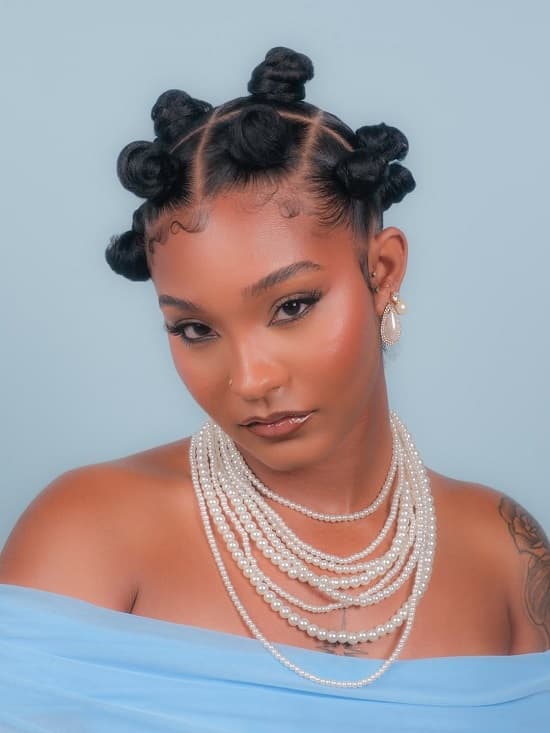
How do you ask for this exact look? The key words are grid pattern and pearl necklace. Thick coily hair of short length is sectioned into clean squares, each one twisted into a tight knot with a small pearl tucked at the center. Ask your stylist for: bantu knots in a grid pattern. The pearl is a quiet accent on top of the geometry. A rat-tail comb and a steady hand are required for keeping the rows straight.
10. Bridal Bantu Knots With Butterfly Clips
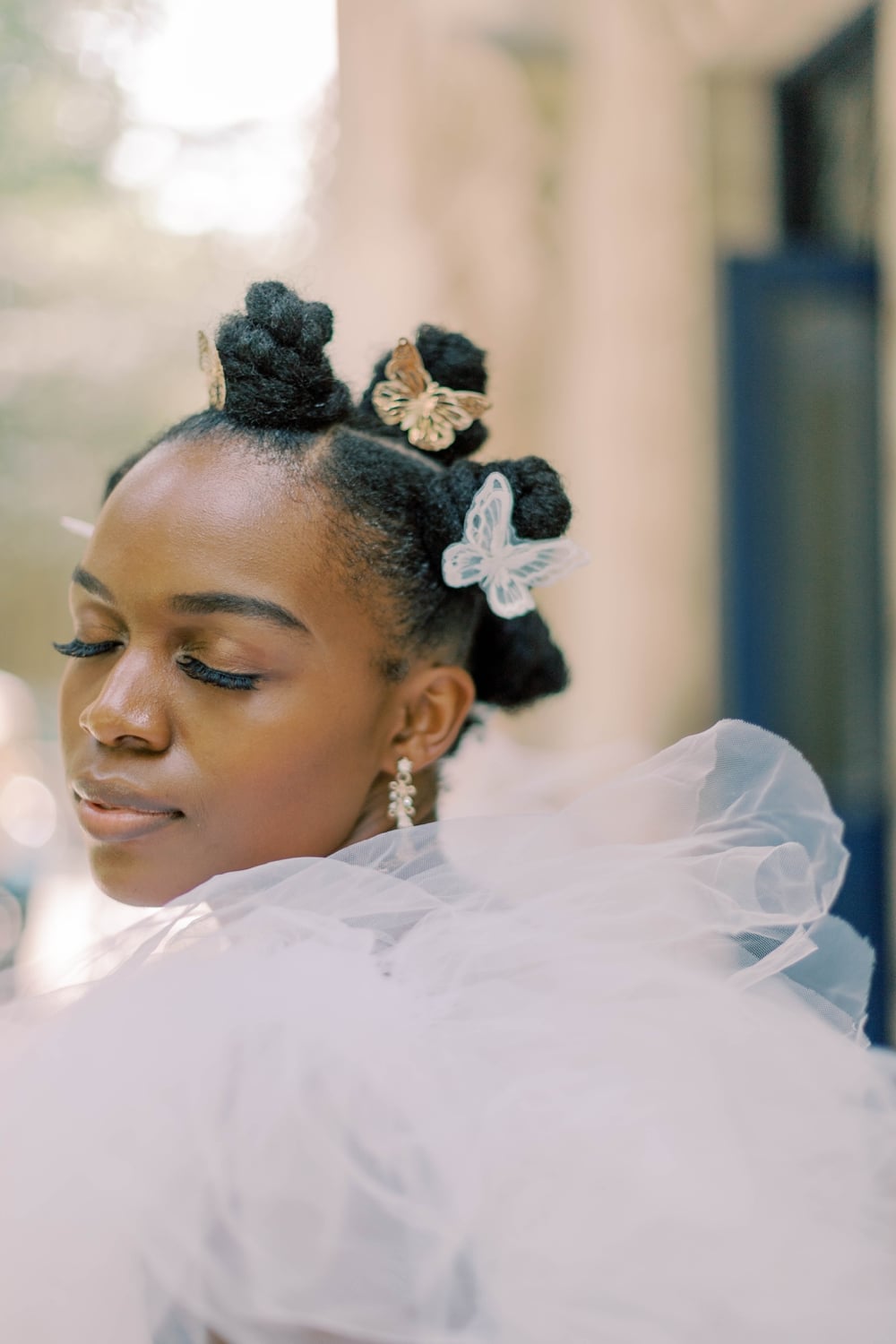
Butterfly clips were not designed to hold up a veil, but they are excellent at dressing up a knot. Classic bantu knots on the crown of the head get a delicate floral accent from each clip. Thick, coily hair at a short length keeps the structure clean. Ask your stylist for: bridal bantu knots with butterfly clips. This style works for a wedding guest or a formal ceremony where the hair needs to stay neat from the first dance to the last slice of cake.
11. Neck Length Bantu Knots With Clips
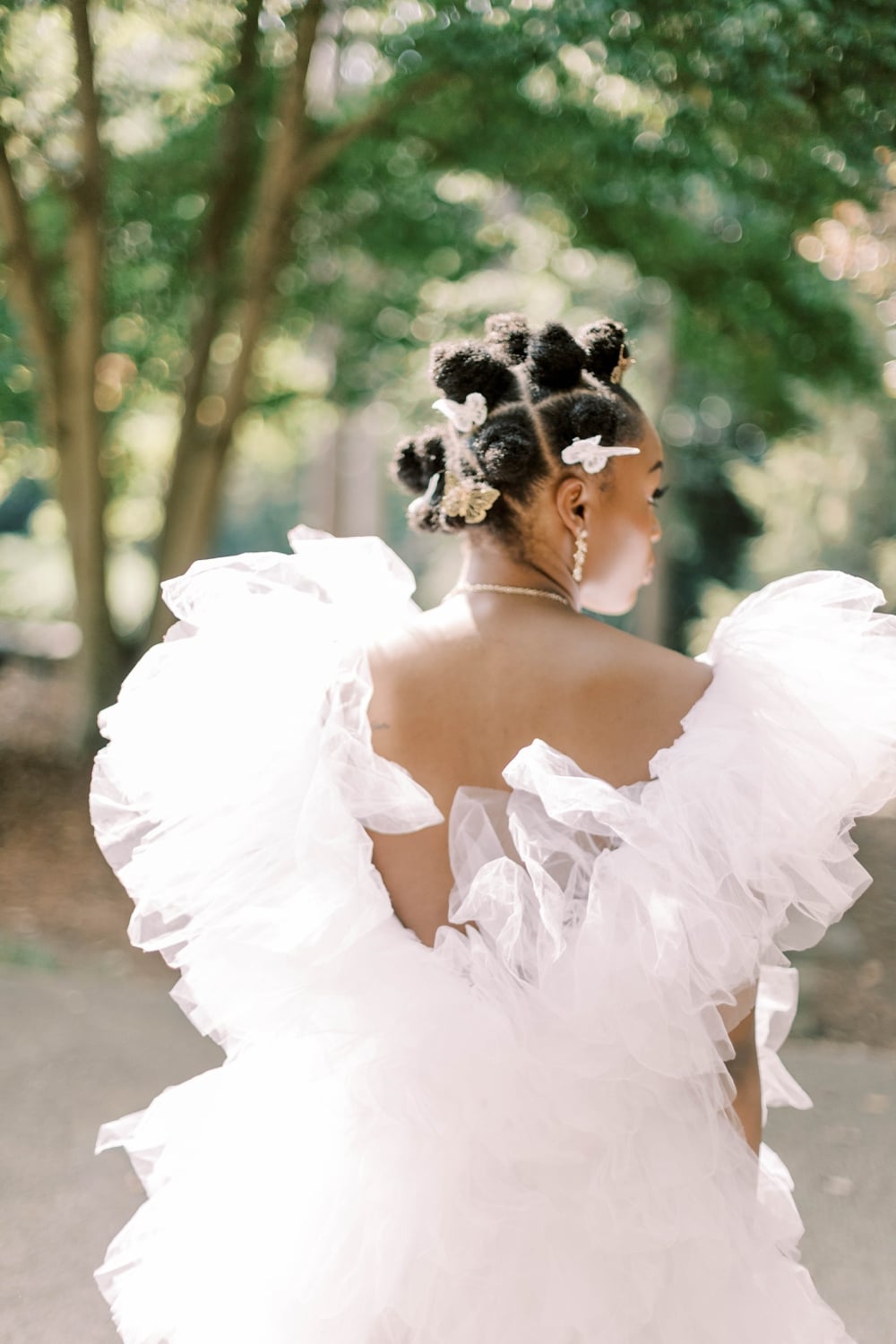
Neck length bantu knots carry their own logic: the shorter the hair, the more each knot pulls its own weight, and the clips are doing real work here, not just decoration. On thick, coily hair that ends at the neck, the knots stay secure, but the added butterfly clips shift the balance.
Ask your stylist for: neck length bantu knots with butterfly clips. The clips catch on the knot base, so they hold best when placed evenly around each one, not jammed through the middle. That middle part keeps the whole arrangement symmetrical, and the neatness reads as formal without any extra effort. A trim every eight weeks keeps the ends from fraying, because neck length gives you no room to hide a ragged edge.
12. Neck Length Bantu Knots With Gold Accents
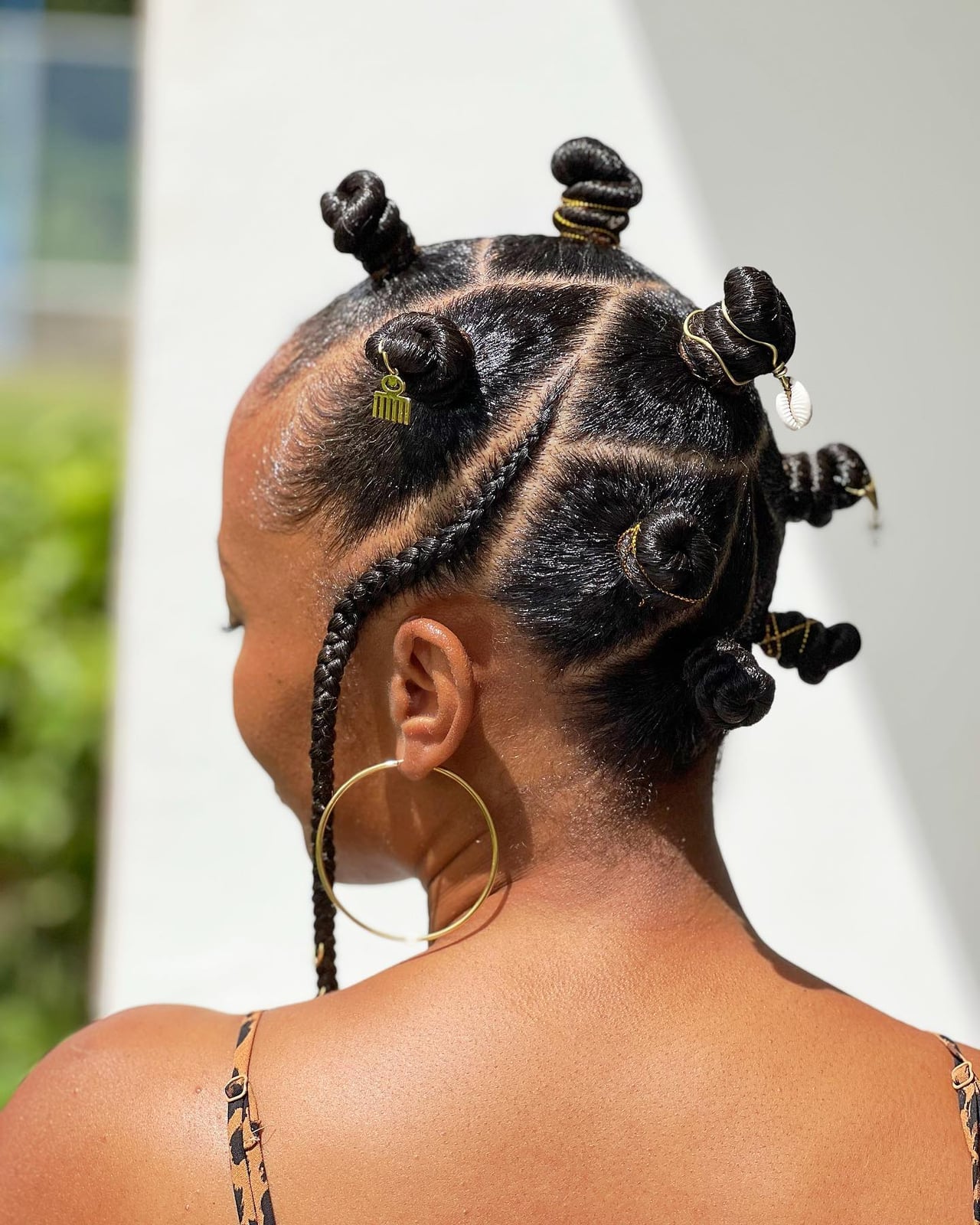
Where the clipped version leans on hardware, these neck length bantu knots swap in gold thread and small charms for a softer, more ornamental finish. The knots themselves are the same: thick, coily black hair, middle parted, wound into shape. The difference is in the wrapping, and that changes how the style behaves.
The thread is woven around the knot base, not through the strand, so it adds shine without pulling at the root. The one real drawback is weight: too much thread and the knots start to droop, especially at neck length where there is less hair to anchor them. Ask your stylist for: neck length bantu knots with gold thread and charms. Keep the accents to a few per knot and the style stays light enough to last the day.
13. Bantu Knots With Shoulder Length Braids
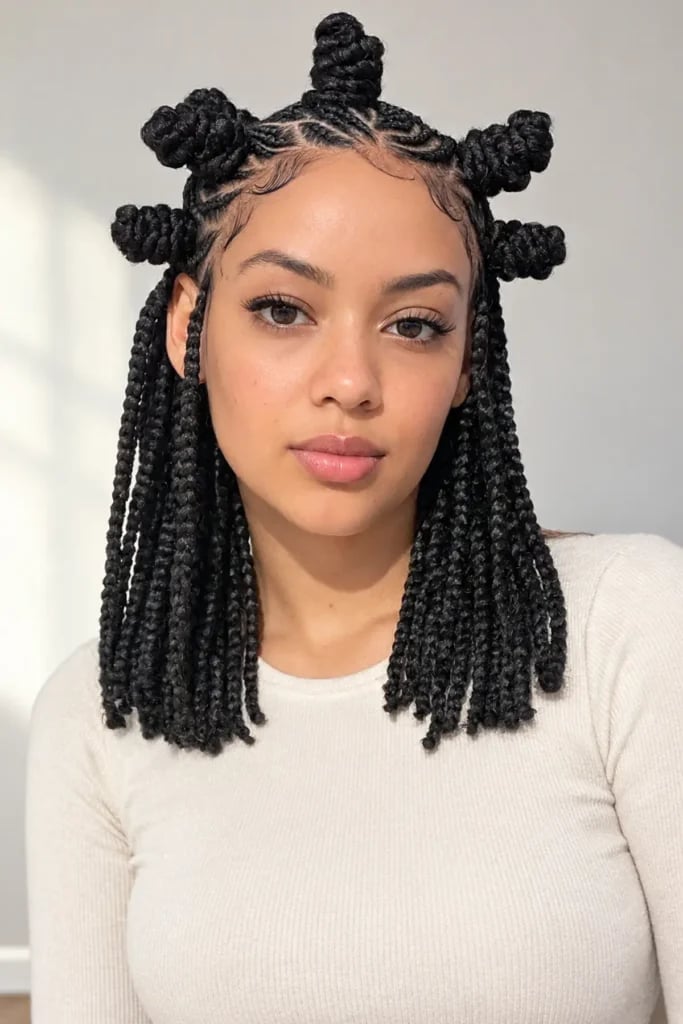
What do you ask for when you want the polish of knots without committing your whole head to them? Knots at the crown, braids everywhere else. The bantu knots sit on top, neat and uniform, and the box braids fall to the shoulders, which keeps the style from feeling top-heavy. The middle part keeps the front clean, no bangs to negotiate.
- Ask for bantu knots with shoulder length box braids, and specify that the braids start cleanly from the knot base.
- Ask for the knots to be sized evenly, so the transition looks like one piece.
Thick, coily hair handles this well, since the braids need enough weight to hang straight.
14. Intricate Bantu Knots and Braids
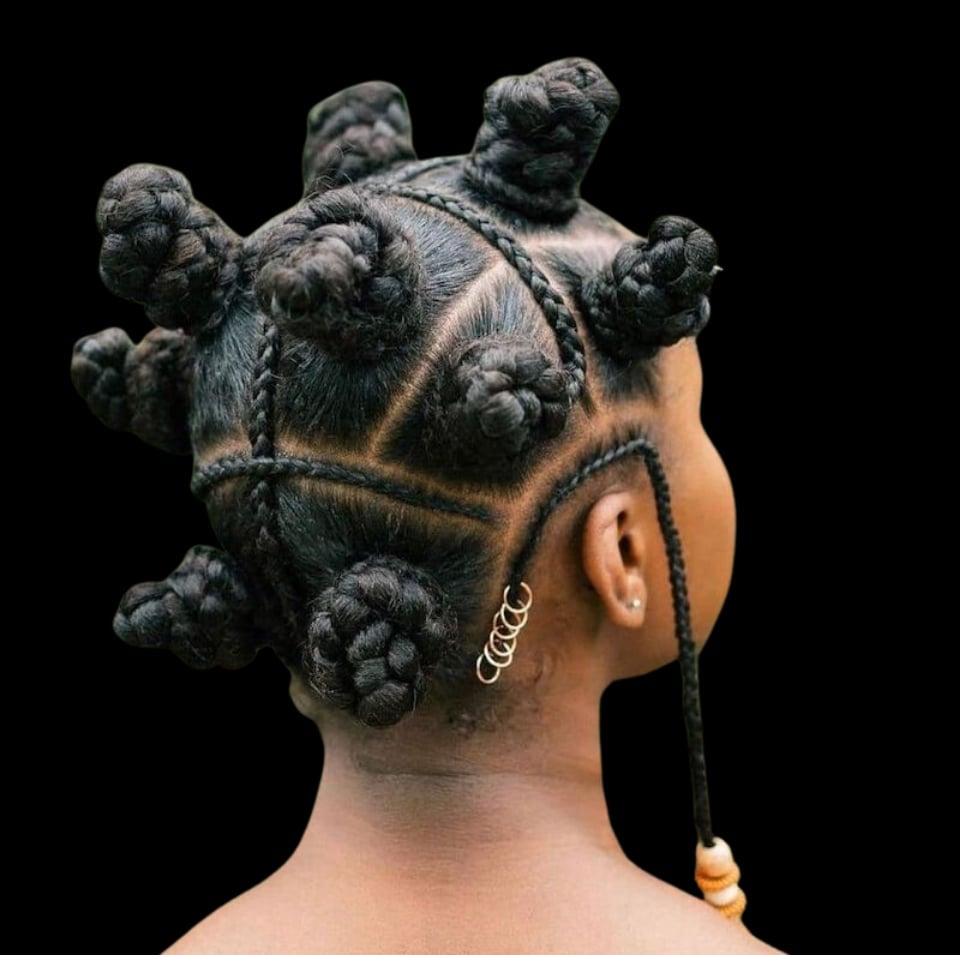
This style stops the room because the bantu knots are doing double duty: they are not just placed, they are arranged into geometric patterns, with braided sections connecting them across the back. Against a simpler all-knot look, this one asks for more time in the chair and more hair to work with, mid-back length at least.
Thick, coily texture is required here, since the knots need density to hold their shape and the braids need weight to stay defined. Ask your stylist for: intricate bantu knots and braids in geometric patterns. The upkeep is mostly about tension: each knot and braid has to be formed tightly enough to last, but not so tight that the scalp complains. A light oil at the roots every few days keeps the style comfortable, and a touch-up visit every four to six weeks keeps the lines crisp.
15. Geometric Parting Bantu Knots
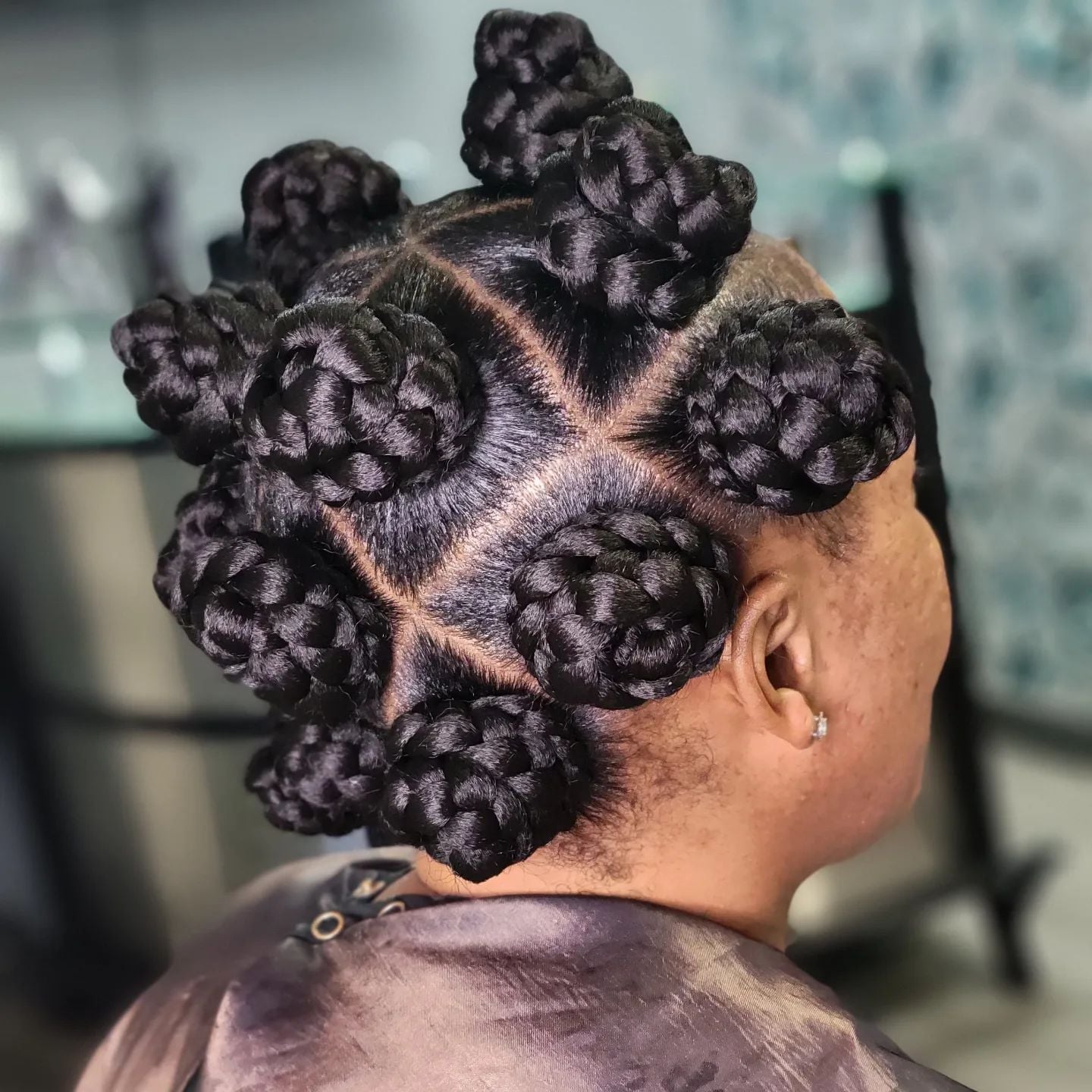
The parting here is the whole show, cut with a pointed comb into clean geometric shapes that frame each knot on dense, coily black hair. The knots themselves are uniform and tightly wound on short hair, and the middle parting keeps the geometry honest.
Ask your stylist for: bantu knots with geometric partings. This is a salon-only proposition, because the precision takes time: two to three hours for the parting alone, before a single knot is tied. The style looks deliberate from every angle, and the short length means it wears light. A trim every six weeks keeps the shape sharp.
16. Heart Shaped Parting Bantu Knots
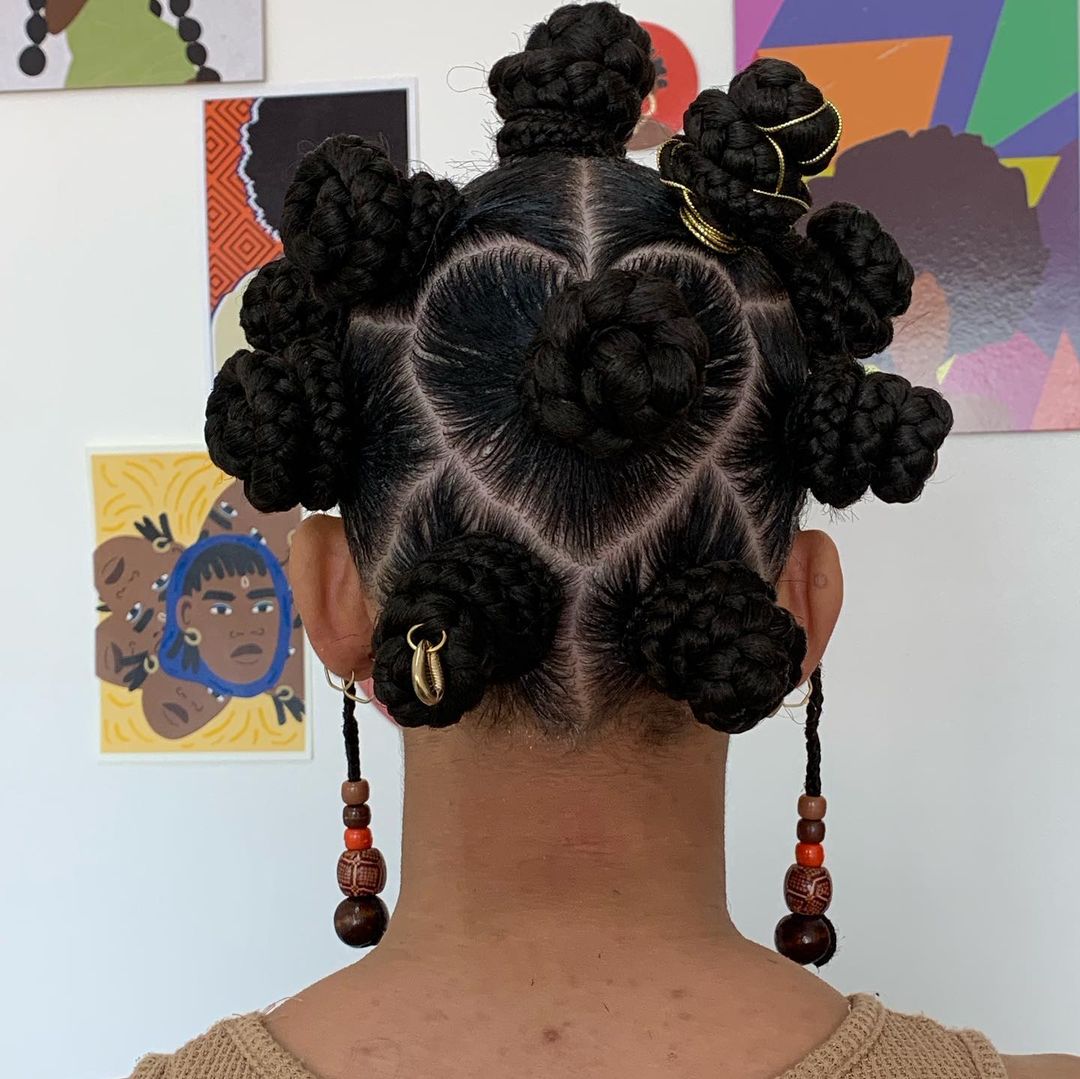
Can a parting actually say something? Here it does: the back of the head carries a heart-shaped parting, with bantu knots arranged around it on thick, coily black hair. This one needs a steady hand and a stylist who can map out the shape before the first section, so the heart reads clearly from across the room. Beads and gold accessories add a festive finish, making it a natural fit for a wedding or Valentine’s Day. Ask your stylist for: bantu knots with a heart-shaped parting. The drawback: the precision means this project requires a professional, not a quick weekend experiment.
17. Side Part Bantu Knots With Gold Beads
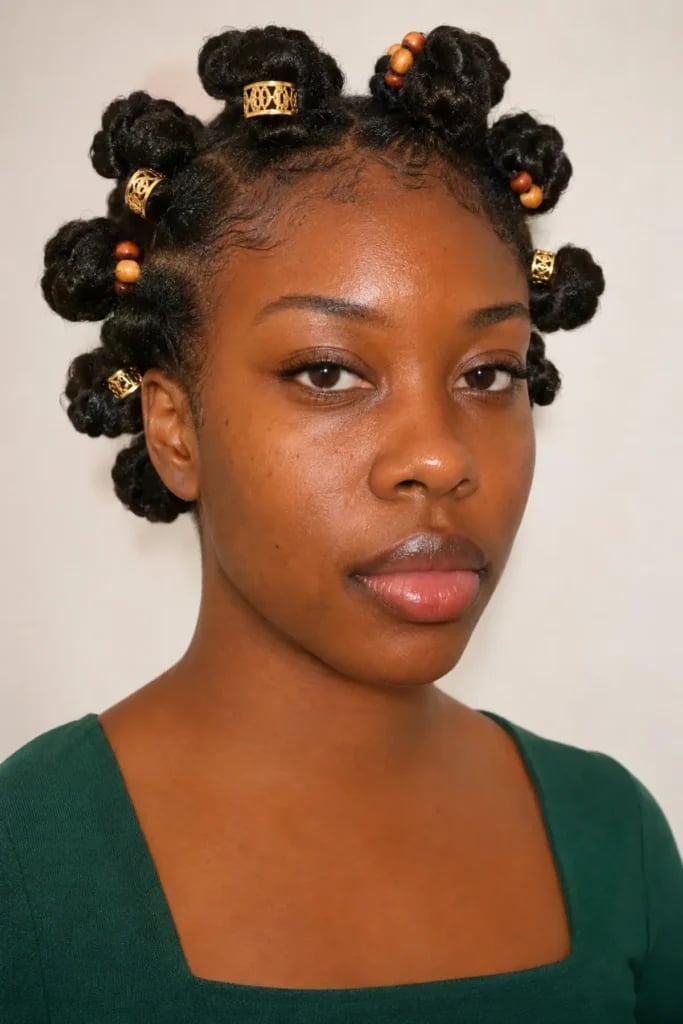
Most bantu knots sit in symmetrical rows, but a deep side part breaks that pattern and adds a bit of asymmetry. On thick, coily black hair at ear length, the knots stay neat while the gold beads and rings catch the eye at each tip. The side part also shifts the visual weight, which can balance a longer face. Ask your stylist for: bantu knots with a side part and gold beads. Specify where the part should fall, and have the beads placed on the ends or along the knots, whichever reads stronger from the front.
18. Prominent Dark Brown Bantu Knots
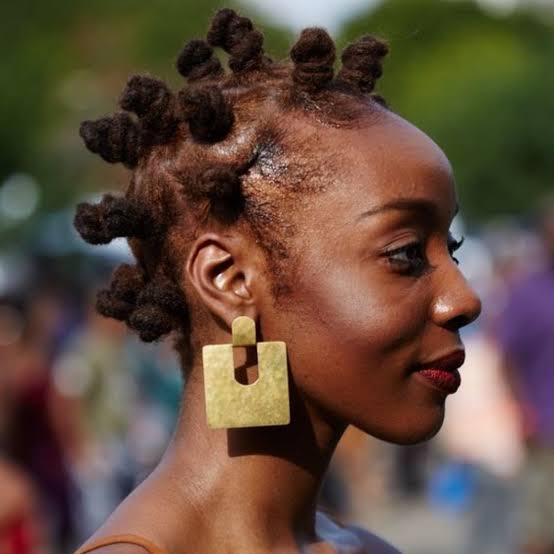
Dark brown is a quiet base, but here the knots do the talking. Each one is distinct and well-defined, rising from the scalp on thick, coily hair cut short. The side profile shows the precise formation, with no stray strands to soften the lines. This is a style that works for everyday wear or the office, since the color is understated while the shape holds its own. Ask your stylist for: prominent bantu knots, dark brown hair. A leave-in conditioner keeps the coils soft and defined between washes.
19. Polished Sophisticated Bantu Knots
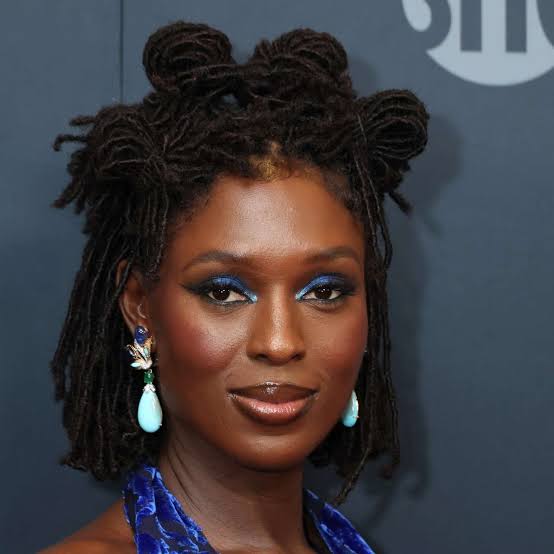
Compared to a looser knot arrangement, this version is almost architectural: uniform bantu knots across the scalp with a clear middle part, all on thick, coily black hair at short length. The neatness is what makes it read as refined, but that same precision is the catch. Getting every knot identical takes time and a patient stylist, and it is not a style you can rush at home. Ask your stylist for: polished bantu knots, middle part. A wrapping lotion smooths the exterior of each knot and keeps the shine up for a formal event.
20. Final Thoughts
For bantu knots, prioritize consistent tension while twisting and secure the base firmly to prevent unraveling. Thick, coily hair benefits from a leave-in conditioner to keep each section smooth and moisturized.
- Refresh knots daily with a light mist of water or leave-in spray.
- Protect knots with a satin bonnet or scarf at night.
- Untwist carefully after 1 to 3 days to avoid breakage.
- Moisturize scalp with a light oil or serum between styles.
Bantu knots: a style that masters elegance and protection.
More Hairstyles ideas
- Slick Back Ponytail Ideas 2027 with Volume
- Aesthetic 4c Hair Styles for Volume and Shape 2027
- Classy Middle Part Hairstyles 2027 for a Polished Look
- Simple Hairstyles 2027 for Black Women Braids with Mid-Back Jumbo Box
- Trendy Bridesmaid Ponytails 2027 for Your Wedding Day
- Trendy Little Girl Hairstyles 2027 for Every Occasion
- Classy Low Bun Wedding Hairstyles 2027 for a Timeless Look
- Classy Crown Braid Hairstyles 2027 for Elegant Looks
- Classy Ponytail with Swoop 2027 for a Polished Look
- Easy Office Hairstyles 2027 for Polished Looks
- Trendy Silk Press Hairstyles 2027 with Bouncy Waves
- Trendy Beach Waves 2027 for Summer Adventures